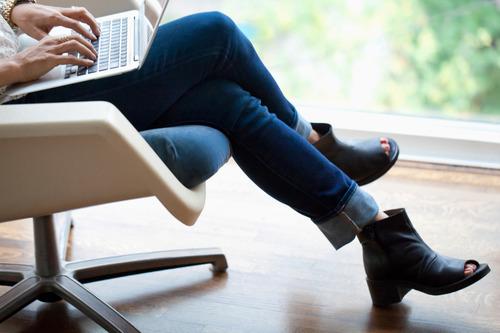
This common way to sit actually comes with health risks. (Photo: Stocksy/Jill Chen)
You
probably cross your legs at least once while you’re having dinner,
working at your desk, or pretty much any time you sit down. Odds are,
you don’t even realize you’re doing it — you just sit and cross one leg
over the other, like you’ve done for years.
But
experts say you might want to rethink that habit: Crossing your legs
can actually have some negative health effects. Here’s what you need to
know:
It Causes Back And Neck Pain
In
a perfect world, you’d sit facing forward with both feet planted
squarely on the floor. Unfortunately, that rarely happens. Most of us
shift our weight around, lean to one side or the other, or, yup, cross
our legs.
According
to orthopedic physical therapist Vivian Eisenstadt, crossing your legs
is just asking for back and neck pain. Sitting with your legs crossed
puts your hips in a torqued position, which can lead to the rotation of
one of your pelvic bones, she explains. Since your pelvis is the base of
support for your spine, it puts unnecessary pressure on your neck and
lower and middle back when it’s rotated and unstable. And the longer you
sit with your legs crossed, the more pressure you put on your spine,
which increases the odds you’ll develop an issue.
“Days
and weeks of doing this are one of the main reasons we have back and
neck pain, as well as herniated discs,” she tells Yahoo Health.
While
it’s unrealistic that you’ll have perfect posture every time you sit
down, she recommends sitting with your knees and ankles at 90 degrees
with your pelvis balanced whenever possible.
Related: 8 Everyday Things That Cause Pain
It’s (Possibly) Linked To Spider Veins
No
one wants spider veins, but they happen — according to the U.S.
Department of Health and Human Services, about 55 percent of women and
45 percent of men in the U.S. have them.
The
medical community seems to be divided on the link between crossing your
legs and spider veins. While some doctors say spider veins are solely
caused by genetics, pregnancy, sun exposure, and frequently standing or
sitting for long periods of time, others like Hooman Madyoon, MD, a
cardiologist at Cedars Sinai Medical Center who specializes in the
treatment of venous diseases, tells Yahoo Health that there is an
indirect link between the two.
He
explains how it works: Crossing your legs increases the pressure on
your veins that are responsible for returning blood back to your heart.
The pressure of one leg on top of the other impedes your blood flow,
which can weaken or damage the veins in your legs. If the veins are
damaged or weakened, the blood can leak into them and collect there,
causing spider veins or exacerbating existing ones.
It Elevates Your Blood Pressure
It’s surprising, but true. Crossing your legs at the knee can temporarily cause your blood pressure to go up.
Here’s
why: The blood in your legs has to be pumped back to your heart against
gravity, explains Madyoon. That’s already a tough enough task for your
body, but when you cross one leg over the other, it increases resistance
to the blood flow. As a result, your body has to increase your blood
pressure in order to push your blood back up to your heart.
You
usually won’t feel any symptoms when your blood pressure goes up, but
repeated, drawn-out increases in blood pressure can cause long-term
health issues. So, planning to sit for a long period of time? Don’t keep
your legs crossed.

No comments:
Post a Comment